URGENT NEED? Secure your communications today.

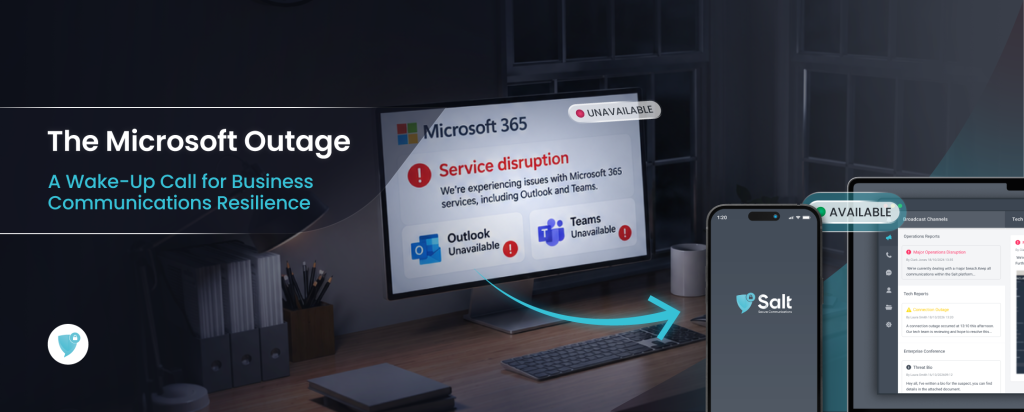
Salt Communications reminds organisations to rethink their reliance on everyday communication platforms following widespread global disruption.
Friday’s global Microsoft outage was a stark reminder of just how dependent organisations have become on the digital platforms they use to communicate, collaborate and operate every day.
With disruption reported across more than 70 countries and territories, affecting Microsoft Outlook, Teams and other Microsoft 365 services, organisations around the world faced difficulties accessing essential systems.
The impact extended well beyond the corporate office. Healthcare providers, police forces, educational institutions, government agencies and businesses of all sizes experienced disruption, highlighting how quickly a technology issue can become an operational challenge.
For many organisations, the immediate concern was not simply when their systems would be restored.
It was how they could continue communicating securely in the meantime.
When communications fail, business continuity is put to the test
Microsoft 365 is deeply embedded in the way modern organisations operate. Email, messaging, meetings and collaboration tools are often relied upon not only for everyday business, but also to coordinate a response when something goes wrong.
But what happens when those very systems become unavailable?
How does an organisation reach its leadership team, communicate with employees, coordinate decisions or share sensitive information when its primary communication channels cannot be accessed?
For organisations without an established alternative, even a temporary outage can create unnecessary uncertainty and delays.
Friday’s disruption demonstrated why communications resilience deserves the same attention as other essential elements of business continuity planning.
Restoring systems is important. Maintaining communication while they are unavailable is equally critical.
For Salt customers, the Safe Haven was already there
While organisations around the world experienced disruption, Salt Communications received feedback from customers who were able to fall back on Salt to continue communicating securely.
Importantly, this included organisations that do not necessarily use Salt as their primary everyday communications platform.
Because Salt operates as an independent, secure communications environment, customers with the platform already established had an alternative place to message, make voice calls, hold video meetings and coordinate their teams when their usual communications systems were disrupted.
For these organisations, the value of having a secure communications Safe Haven was not theoretical.
It was something they could turn to when their normal channels were unavailable.
Salt can be used for secure everyday business communications, providing organisations with greater privacy, control and compliance. Equally, it can serve as an independent communications environment for operational resilience, providing an established alternative when primary systems are disrupted or cannot be trusted.
The distinction is simple: organisations should not have to establish their fallback communications at the very moment they need them.
Joe Boyle, CEO of Salt Communications: A reminder to prepare before disruption happens
Joe Boyle, CEO and Co-Founder of Salt Communications, believes the outage should encourage organisations to reconsider whether their existing business continuity plans adequately address secure communications.
“Friday’s Microsoft outage demonstrated something that we have been highlighting to organisations for years. Businesses invest significant resources in protecting their infrastructure and recovering their systems, but what happens to their people and their communications when those systems become unavailable?
“We heard from Salt customers who were able to fall back on our secure communications environment and continue communicating during the disruption. Some use Salt for their everyday communications, while others have it established specifically as an independent Safe Haven.
“The important thing is that they already had somewhere secure to go.
“No organisation should find itself trying to establish an entirely new communications process in the middle of an outage. The people, the platform and the processes should already be in place and familiar to those who need them.
“My advice to business leaders is straightforward: look at what happened on Friday and ask whether your organisation could have continued communicating securely if its primary systems were unavailable. If you don’t have a clear answer, now is the time to address it.”
– Statement from Joe Boyle, CEO and Co-Founder, Salt Communications
Secure communications should not depend on a single environment
The Microsoft outage was not reported to be the result of a cyberattack. Microsoft attributed the disruption to a technical issue associated with network changes.
That distinction is important.
Organisations do not need to experience a cybersecurity incident to lose access to critical communications. Technical failures, cloud service disruptions, infrastructure problems and cyberattacks can all create situations where established communication channels become unavailable or untrustworthy.
Having an independent communications environment helps reduce reliance on any single provider or system.
And independence alone is not enough.
A meaningful communications fallback should be securely established, with authorised users, appropriate access controls, relevant groups and clear processes already in place.
It should be familiar to the people expected to use it and ready to support secure coordination when required.
A moment for organisations to reflect
As businesses return to normal following Friday’s disruption, Salt Communications is encouraging leadership teams, IT departments and business continuity professionals to consider an important question:
If your organisation lost access to its primary communications platforms tomorrow, would your people know exactly where to go?
For organisations that already have an independent secure communications environment, Friday demonstrated the value of being prepared.
For those that don’t, it provides an opportunity to assess existing arrangements and identify where improvements may be needed.
Because when disruption happens, you don’t want to be searching for a Safe Haven. You want to know you already have one.
Talk to Salt Communications
Whether your organisation is reviewing its communications resilience, exploring an independent fallback solution or simply looking for advice, the Salt Communications team is available to help.
Find out more about preparing for communications disruption:
When Microsoft Goes Down, Where Does Your Business Go?
Or arrange a conversation with our team.
About Salt Communications
Salt Communications provides a secure, enterprise-managed communications platform for messaging, voice calls, video meetings and collaboration. Designed for organisations requiring enhanced security, privacy and control, Salt supports secure everyday communication and provides an independent Safe Haven when primary communications systems are unavailable or compromised.